Now Some Economics For Some Reason Part I: Science? No. School!
Why don’t we just print more money? Why doesn’t the government employ people to dig holes and fill them back in? Why does the interest rate on your bank account change? Why is the housing market difficult? What are bond markets, and why are they important? Wait, why do we even need to use money in the first place?
Economics, that’s why. The dismal science that permeates our daily lives. It’s important. And yet no one seems able to agree on the right answers.
Why?
Going to School
Dismal, yes. Science? Not quite.
Because we can’t run through the following pipeline:
conjecture → deduce consequences → attempt empirical falsification
The environment is constantly changing, the problems that we are trying to solve change before the old ones can be solved, or the solution was tested. And even if it was tested, we won’t know if the theory was falsified because of things like feedback loops and the complexity of the environment.
We cannot deduce the consequences of changing the economic model, nor falsify these consequences even if we had them.
What we’re left with a messy collection of theories, data, statistics, econometrics, politics (the subject itself used to be known as political economy), and ethics.
In Economics, schools of thought are more important than in natural science. These divergent schools all have serious intellectual backing and real-world implementations.
When discussing economics today, it’s useful to be aware of the (main) schools of thought. So then here’s a quick summary of The Schools and what they arose as a response to/in the context of:
- Classical Economics: market co-ordination via the Smithian invisible hand. Ricardo, Smith, Malthus, Mill. Early capitalism, mercantilism, free trade, expanding global trade.
- Communism: markets are exploitative, we can seize and share capital in a better way. Marx, obviously. Factory workers in harsh conditions. Bifurcated, massively-unequal societies.
- Keynesian: the government should manage and stimulate the economy. Keynes, obviously. Centralised economies (vital for war efforts). Mass unemployment due to The Great Depression.
- Austrian: markets coordinate info better than governments, who should not intervene. Menger (early), Mises (late), Hayek (later). An alternative response to early 19th century economies and to Keynes’s ideas (later).
- Monetarism: central banks should focus on the money supply, the government should largely stay out of the way. Friedman. Stagflationary 70s, Cold War, deregulation, financialisation.
You may be thinking - if the context, the environment, the economies in which these Schools arose, analysed, and suggested policies for, has changed, how much are they still relevant today…?
Like does Austrian Economics make sense in modern-day Ethiopia? We’re not really sure.
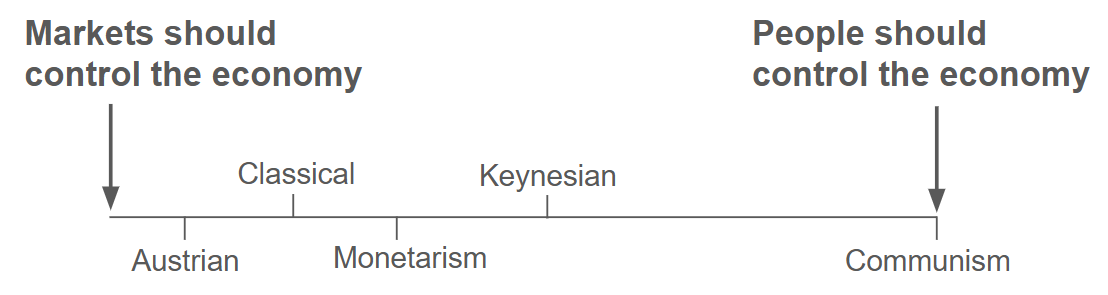
The way I think about these Schools is to what extent their proponents believe the economy should be run by markets vs. people:
The Modern Synthesis
Economics nerds are probably screaming that I’ve missed out The Big One: Neoclassical Economics.
Continuously morphing since origination in the late 19th century, today it forms the basis for how most professional economists think about economics:
- Supply and demand (at a micro and macro level)
- And rational actors
- Combine at the margin to push markets towards equilibrium
- In processes that are tractable and defined mathematically
Historically it implies that economies should largely be run by markets, that rational actors + supply-demand will bring us to market equilibrium.
But some modern economists sort of implicitly argue that because NE gives us a detailed, mathematical comprehension of markets and the economy, we have the power to press certain economic buttons to guide the economy to where we want it to go, even if these models are approximations. If markets really are governed by price elasticity, supply curves, etc., really are just rational agents maximising expected utility, then tweaking variables in the equations that describe these markets can, will lead to outcomes that can be understood. And because these markets scale and aggregate all the way up, we can press these magic buttons at any level we want. Like e.g. the economy; as in the whole economy can be defined by an equation, literally:
Y = C + I + G + (X - M)
The Keynesian-Neoclassical combo that logically mandates intervention to “fix” the economy whenever inflation is too high/low, when the GDP line is not steep enough, or when employment is less than 99%. Hence interest rate setting, interest rate expectations, quantitative easing, money printing, budgeting everything, economic forecasts, borrowing, and more borrowing. Although, yes, there are other factors and models influencing these decisions.