Now Some Economics For Some Reason Part II: Everything and More
[Prologue] Where Are My Sardines?
I eat a lot of sardines. So when I found the Tesco’s sardines section alarmingly sparse on my weekly shop a few months ago, I started to panic. Local shortage? Had Tesco lost some big sardines contract? Alas, Sainsbury’s, too, no sardines. Oh no.
Turns out there had been a dramatic drop in sardine yield off the coast of Morocco. Morocco supplies the majority of the UK’s sardines. So no sardines in Morocco means no sardines in the supermarkets in the UK.
The explanation of how and why this occurred, like much of modern life, requires some understanding of economics.
The first question to ask is why UK supermarkets reliant on moroccan sardines? Can’t we produce our own? That’s comparative advantage: it is a more effective use of our resources to import sardines from elsewhere.
And why are yields down? Negative externalities. Pollution has been leading to increasing sea temperatures, which disrupted the food supply (plankton on which they feed are struggling to survive in warmer waters). Plus overfishing.
Usually when shortages happen, price increases (due to supply-demand dynamics), and the highest bidders still get to consume the good. However, in this case, Morocco decided to ban the export of frozen sardines. Why? To combat domestic inflation and safeguard local food security. Economics, again.
To explain the modern world, you need economics.
All You Need to Know
First of all, you may ask yourself why we even need money in the first place. If I have a bit of wood and you have some steel, why can’t we just swap these? No need for the economy. You can. We can. But what happens when there are more than two parties involved? You’ll very quickly realise that trade explodes in complexity. We use money as a medium of exchange to allow us to price everything in the economy. Price here is a verb. Pricing something means determining how much money that both parties are willing to exchange the item for, that the seller is willing to take and the buyer is willing to give up. This happens via markets. Prices tell us how much things are worth, which allows us to allocate capital to the production of things in the economy that are valuable to market participants.
This system only functions correctly if the total amount of money in circulation is constant. If this money supply changes, it’s difficult to determine if the change in price for an item is due to changes in the money supply, or changes in demand/supply of the item.
We used to control the amount of money in circulation via The Gold Standard, which is the mandate that the money supply can only increase at the same rate that we mine gold. This may sound arbitrary. That’s because it is. But it at least instills practical limits on increases in the money supply, limits that governments are not bound by today.
We came off The Gold Standard in 1931, so now we effectively have the ability to print more money out of thin air whenever we want. We don’t do this, because of the negative effects of doing so, of inflation. Specifically, fears of excess inflation, that can pretty much delete money as a viable medium of exchange.
This is complicated by the fact that money, the domestic money like GBP, exists in a global system of currencies. Most countries have their own economic policies and own currency (it is difficult to have one without the other). External participants also affect the money supply by buying and selling GBP as part of international trade. We have trade because of comparative advantage: it is more effective to produce what you can at lower cost and trade with other countries who can do the same for other goods and services. This can lead to hefty trade deficits if you import far more than you export. We’re not really sure how bad trade deficits are.
The supply is also affected by the market for money: foreign exchange markets, in which currencies are priced relative to other currencies.
But it tends to be domestic policy that has the largest effect on the money supply (AKA, to simplify, on inflation). One way to influence inflation is via interest rates. These are set by central banks, technically independent from the government, that set the baseline interest rate in the economy. This is the interest rate that:
- is applied to corporate bank deposits at the central bank
- is used to set the interest rate on important variable-rate loan products (like mortgages)
Corporate banks hold your money for you as deposits (and pay you some interest to do so), then lend out (a multiple of) this money. Side note: this mechanism also increases the money supply. Higher interest rates on corporate bank deposits mean that holding money with the central bank becomes more profitable. Lending becomes relatively less attractive. As does investment. Consumer interest rates tend to rise as banks undercut each other, so spending for consumers becomes less attractive, too. This is also caused by higher interest payments on loans.
Some inflation does also come from supply. E.g. when the price of oil rises because of a war or sanctions or supply-chain disruptions, the price of everything else tends to increase as well (oil is actually special here because it is intrinsic to much of economic activity). Supply-demand: oil is rare but vital hence high(er) prices.
The measures to counter (demand-side) inflation do tend to work (good), but at the same time they are likely to slow the growth of the economy (bad). We define “the economy” by Gross Domestic Product (GDP). Real GDP adjusts for inflation.
If RGDP go up it mean we make more stuff which good.
Well, sort of. You might be asking yourself, why is economic activity intrinsically good?
At a fundamental level, it’s the number of transactions in which both parties benefit. Sellers would have the money than have the good, and buyers would rather have the good than the money. Win-Win.
But GDP is not a perfect measure of this. If the government spends a load of cash, that will make GDP go up. Yay. But was it a good thing to do? In a sense, yes. Unless that spending was completely frivolous, then it probably had some positive impact on society and quality of life. And even if it was (frivolous), that spending is someone else’s income, which they can spend, which in turn is someone else’s income, which they can then spend, etc. But was capital allocated effectively? There is no direct transaction here, no agreement between buyer and seller.
We’ve already talked about monetary policy: control of interest rates and the money supply. But governments can also use fiscal policy, which describes how they collect taxes and spend them. The money the government spends it has to collect from the people it governs. So spending more means taxing more. It’s often unclear if this is a good idea or not.
Sometimes the government wants to spend more but doesn’t want tax more because this makes them a bit sad. What do you do when you want to spend money you don’t have? You borrow. Buy now, pay later. Which is exactly what the government does: it borrows money. This is what government bonds are - loans to the government. They work the same way as any other loan: if you think the borrower is reliable, you’ll get a lower interest rate. But something works slightly differently with government bonds; because the borrower determines the supply of the money the bonds are denominated in, the borrower (remember, the gov) can always repay the loan by effectively printing money. So government bonds interest rates are a reflection of predicted future inflation, rather than ability to pay.
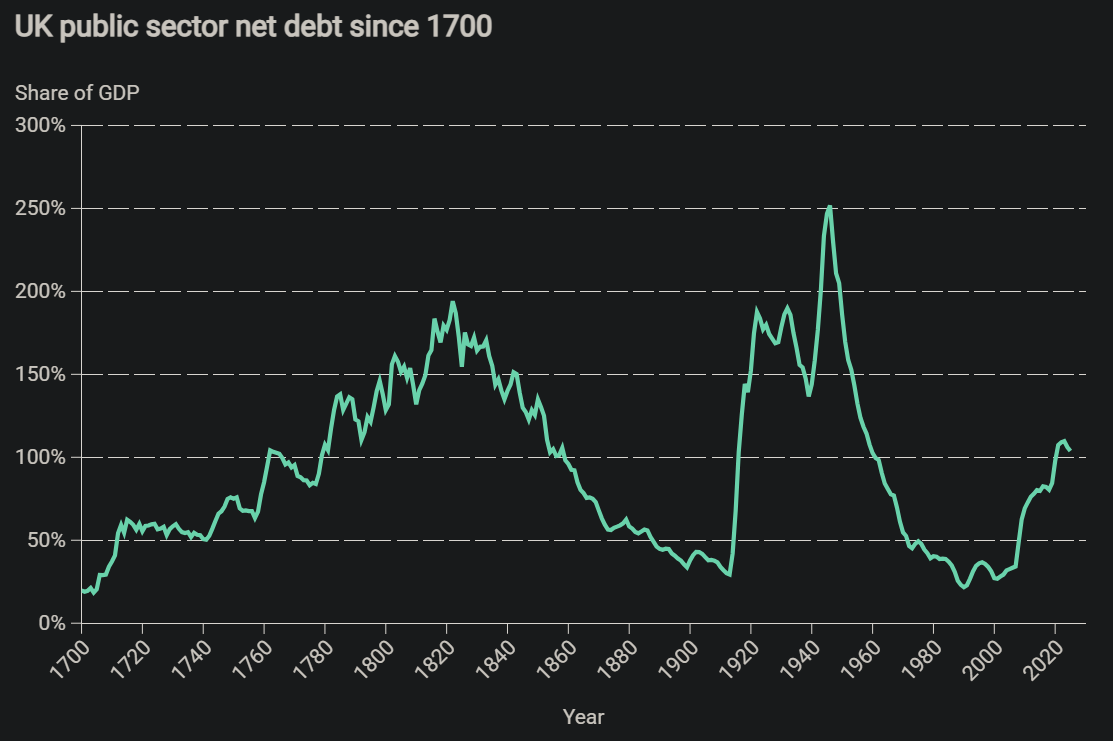
If the economy is not growing, or the government changes its policies, they may not be able to collect as much tax revenue, maybe even less than they spent for that year. Enter the deficit: money collected - money spent = amount needed to be borrowed. So it (gov) will need to either cut spending, borrow more, or print money to satisfy bond payments… and they need to do this in order to borrow more money to fund future spending…and bond payments. You can see how a stagnant economy + government debt binds governments to the bond market: they must either cut spending, print money, or borrow more, or else it will be increasingly expensive to borrow money, which they need to do if they have a deficit. But cutting spending may shrink the economy and printing money will increase the interest rate on future bonds. The least painful option is to borrow more.
[Epilogue] Tax Yachts
Imagine you find yourself in a nasty deficit. One thing you could do is to try and increase tax revenue. But how? Taxation is bad for business. It reduces income, which is equivalent to consumption. GDP might go down.
Suddenly you think of a genius idea: tax something purchased by people that are so rich, that 99.9999999% of people will support the policy, and you’ll get needed extra revenue.
You decide to introduce a hefty yacht tax: 10% extra flat tax on yacht purchases. Last year this would have generated £500M in tax revenue. You’re counting the money already.
However, after the announcement, suddenly all the yacht manufacturers start to mysteriously disappear. Rather than eating into their margins, or passing on the cost to their customers (who can pop over to The South of France, an hour away, to buy their yachts), they’d rather move their operations to somewhere else.
So they do. So now rather than £500M in extra tax revenue, we get rich people spending less time and money in our economy, we get disused yachting shipyards, we get less corporate tax from the companies that build yachts, and we get all the workers involved in the construction –> unemployed - maybe we lose these productive workers, maybe they start receiving welfare, maybe they turn to crime.
Turns out a policy that seems obvious is in reality massively net-negative for the economy.
Economics is hard.